Program Learning Outcomes
This program combines courses in general education and radiography with supervised clinical experience in area hospitals and diagnostic imaging centers. Graduates are eligible to apply to take the American Registry of Radiologic Technologies Examination in Radiography and become nationally certified and also licensed by the State of New Jersey.
Students who have completed the program should be able to:
- Students will demonstrate professionalism and clinical competence, ensuring the comfort, dignity, and safety of patients while maintaining ethical standards and professional conduct
- Students will demonstrate effective patient care with professionalism
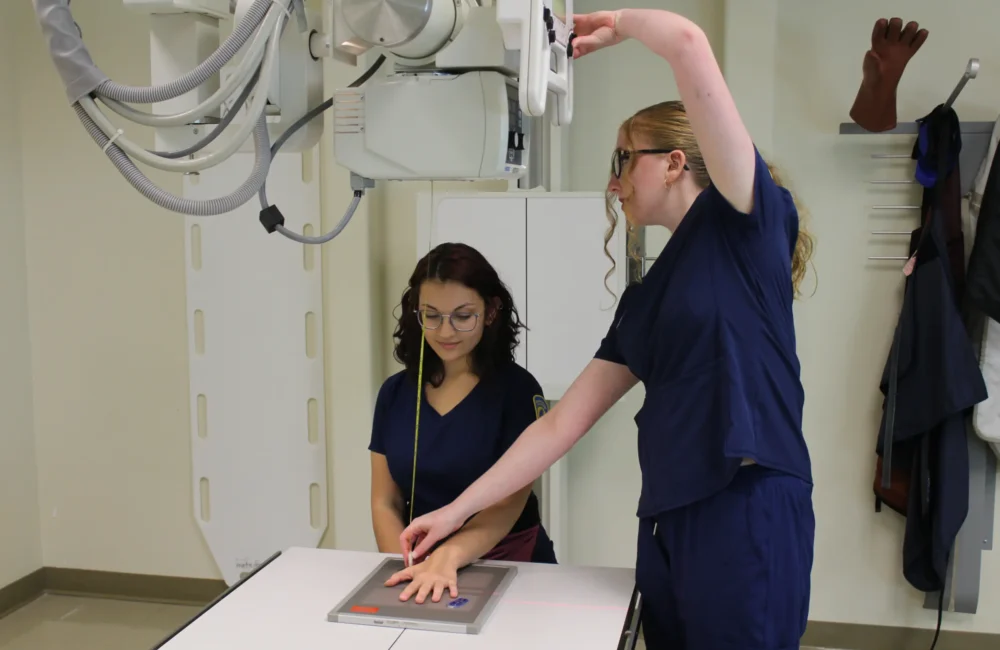
- Students will position patients correctly for a variety of exams
- Students will display effective communication skills with a diverse population, using clear, respectful, and professional language to engage with patients, peers, and other healthcare professionals
- Students will communicate effectively in the didactic setting
- Students will communicate effectively in the clinical agency
- Students will implement safe practices using critical thinking as demonstrated by effective clinical reasoning
- Students will adapt standard procedures for non-routine patients
- Students will critique images for optimal diagnostic quality
View the Program Guide for more information about courses and semester sequencing.
Selective Admissions
This program at RCSJ is a selective admissions program. After completing the general RCSJ application and being accepted to the College, the applicant must submit a separate application (portfolio) for their program of choice and attend an information session. Each program accepts one cohort of students per academic year.
RCSJ offers the Associate of Applied Science degree in Radiography at the Cumberland campus. Radiographers create images of the body, using x-rays to provide physicians with critical information enabling proper patient diagnosis and treatment. RCSJ’s Radiography program combines courses in general education and radiography with supervised clinical experience in area hospitals and diagnostic imaging centers. Graduates can apply to take the American Registry of Radiologic Technologist Examination in Radiography. Graduates can also become nationally certified and apply for licensing by the State of New Jersey.
Additional Information
This program is accredited by the Middle States Commission on Higher Education.
This program is accredited by Joint Review Committee on Education in Radiologic Technology and the State of New Jersey Department of Environmental Protection Bureau of X-ray Compliance.
The Rowan College of South Jersey (formerly known as Cumberland County College) Radiography Program was established in 1986 and accredited in September 1988. The program consists of a two-year full-time course beginning in the first week of September each year.
The radiography program is accredited by the:
Joint Review Committee on Education in Radiologic Technology
20 North Wacker Drive, Suite 2850
Chicago, IL 60606-3182
312-704-5300
Email: [email protected]
The program's current award is 8 years. General program accreditation information and the current accreditation award letter can be found here:
https://www.jrcert.org/programs/rowan-college-of-south-jersey/
JRCERT Standards & Non-Compliance Policy
State of New Jersey Department of Environmental Protection Bureau of X-Ray Compliance
P.O. Box 420
Trenton, NJ 08625-0420
(609) 984-5890
Mission of the Radiography Program
To empower aspiring radiographers with comprehensive theoretical knowledge and hands-on skills, fostering a commitment to excellence in patient care, diagnostic imaging, and technological advancements, while instilling a strong sense of ethical responsibility and professional integrity.
Goals and Student Learning Outcomes
Goal 1. Students will demonstrate professionalism and clinical competence, ensuring the comfort, dignity, and safety of patients while maintaining ethical standards and professional conduct in the clinical agencies.
Student Learning Outcomes:
1.1 Students will demonstrate effective patient care with professionalism.
1.2 Students will position patients correctly for a variety of exams.
Goal 2. Students will display effective communication skills with a diverse population, using clear, respectful, and professional language to engage with peers, and other healthcare professionals.
Student Learning Outcomes:
2.1 Students will communicate effectively in the didactic setting.
2.2 Students will communicate effectively in the clinical agency.
Goal 3. Students will implement safe practices using critical thinking as demonstrated by effective clinical reasoning.
Student Learning Outcomes:
3.1 Students will adapt standard procedures for non-routine patients.
3.2 Students will critique images for diagnostic quality.
Credentialing Examination: The number of students who pass, on the first attempt, the American Registry of Radiologic Technologists (ARRT) certification examination, or an unrestricted state licensing examination, compared with the number of graduates who take the examination within six months of graduation. The five-year average benchmark established by the JRCERT is 75%.
Credentialing Examination Rate | |
Year | Results |
Year 1 - 2022 | 9 of 9 – 100% |
Year 2 - 2023 | 11 of 11 – 100% |
Year 3 - 2024 | 10 of 11 – 90.9% |
Year 4 - 2025 | 16 of 16 – 100% |
Year 5 - 2026 | 15 of 15 – 100% |
Program 5-Year Average | 61 of 62 – 98.2% |
Job Placement: The number of graduates employed in the radiologic sciences compared to the number of graduates actively seeking employment in the radiologic sciences within twelve months of graduating. The five-year average benchmark established by the JRCERT is 75%.
Job Placement Rate | |
Year | Results |
Year 1 - 2022 | 9 of 9 -100% |
Year 2 - 2023 | 11 of 11 – 100% |
Year 3 - 2024 | 11 of 11 – 100% |
Year 4 - 2025 | 16 of 16 – 100% |
Year 5 - 2026 | 15 of 15 – 100% |
Program 5-Year Average | 62 of 62 – 100% |
Program Completion: The number of students who complete the program within the stated program length. The annual benchmark established by the program is 75%.
Program Completion Rate | |
Year | Results |
2026 | 15 of 17 |
Annual Completion Rate | 88% |
- If you are not nor have been an RCSJ student, complete and submit a general admission application online selecting Biological Health/Health Science as your major.
- Submit an official copy of your high school transcript documenting high school graduation (or earned GED) to the Admissions Office.
- If applicable, submit official transcripts from other colleges attended to the Admissions Office.
- Provide documentation to satisfy RCSJ Placement Criteria of complete Accuplacer testing (or provide SAT scores). Complete all required remediation before applying.
For admission assistance or questions regarding application status, call/text the Admissions Office at 856-200-4848 or email: [email protected]
Selective admissions describe programs in which the applicant must meet additional admissions criteria beyond general acceptance to the College and submit a separate application (portfolio) for their program of choice. Each program accepts one cohort of students per academic year.
Applicants are required to include all documents listed on the Radiography Admission checklist as a single completed packet and submit it to the Admissions Office.
Selective Admissions PageCollege-level placement: Applicants must demonstrate college-level proficiency in Reading, English, and Mathematics. Any required developmental or remedial coursework must be completed prior to applying to the Radiography Program.
Applicants should also have a background in high school Algebra, Biology, and Chemistry. Those who do not have this preparation, or who are returning to school after an extended absence, may satisfy these requirements by completing appropriate college coursework and/or placement testing.
Anatomy and Physiology I pre-requisite: High School Biology or General Biology I and High School Chemistry or General Chemistry or Introduction to Chemistry. Final course grades must be C+ or higher and college level English placement.
Admission consideration to the Radiography Program requires general admission to RCSJ and a completed Selective Admissions portfolio submitted to the Cumberland Admissions Office by the due date. All applicants must submit the required documents as a single packet for the year they wish to apply by the designated deadline.
Meeting or exceeding all admission requirements does not guarantee admission into the program.
Students who are accepted in the Radiography Program must be in good health and be able to meet the physical demands of the career. Evidence of good health is documented in the results of a complete physical examination signed by the applicant's physician. Complete acceptance to the Radiography Program is contingent upon the submission of the completed medical form, including drug testing, and successful completion of a criminal background check. The Medical Form and additional information regarding the background check will be provided to the applicant following the initial acceptance letter.
Minimum Standards for Radiography Program Admission
Students wishing for admission into the Radiography Program must be high school graduates or have earned GED equivalency. In addition, they must meet the following minimum criteria.
- HSRT entrance exam, applicants must score 77% or above
- Minimum GPA of 2.50 or above
- Eligibility to register for A&P I in the Fall semester (Must have completed Biology & Chemistry)
- Completion of a college-level Medical Terminology course with an obtained grade of B or above
- Attend a mandatory information session, registration dates and times are posted on the Selective Admissions web page.
Students who do not meet the above criteria will not be considered for Radiography Program admission. Students meeting the above criteria are eligible to be considered for admission but are not guaranteed acceptance into the program.
Admission Scoring is as follows:
Value | Ranking Criteria |
45% | HSRT – minimum composite score 77% |
10% | Medical Terminology Course Requirement (Grade of B or above) |
20% | Science Course Requirement (Grade of C+ or above) |
5% | In-Person Science Course (Only applicable for Anatomy & Physiology I and Anatomy & Physiology II) no hybrid |
20% | GPA Requirement (Minimum 2.50) |
RCSJ will count transfer credit hours that are accepted toward a student's educational program as both attempted and completed. Transfer credits are not counted in GPA.
Please note that radiography-specific courses from other radiography programs cannot be transferred to the RCSJ Radiography program. This ensures consistency in the quality of our students' education and training.
The transfer student will be subject to all RCSJ-Cumberland Radiography Program policies and procedures and must meet all program completion/graduation requirements.
Rowan College of South Jersey does not have articulation agreements with 4-year colleges specifically for Radiography. However, graduates of the program can easily obtain Bachelor and Master degrees through the University Center located on the Cumberland Campus. For more information go to:
https://www.rcsj.edu/UniversityPartners
Once accepted into the Radiography Program, students will be assigned to clinical agencies for the hands-on clinical component of their education. Throughout the program, students will rotate through multiple clinical agencies to ensure exposure to a diverse range of patient populations, imaging procedures, and healthcare environments. Students are responsible for providing their own transportation to all clinical assignments. While geographic location may be considered when making placements, assignment to a specific clinical agency cannot be guaranteed.
The following hospitals and offices are approved by the JRCERT as recognized Clinical Education Settings. Clinical sites are subject to change.
Arthritis & Rheumatology Association of SJ
2848 S. Delsea Drive, Vineland, New Jersey 08360
856-794-9090
Atlantic Medical Imaging (-EHT)
6529 East Black Horse Pike, Egg Harbor Twp, New Jersey 08234
609-677-9729
AMI at Inspira - Vineland
1450 E. Chestnut Avenue, Building 4, Suite A, Vineland, NJ 08360
856-794-1700
AMI at Inspira - Delsea
352 S. Delsea Dr. Vineland, NJ 08360
856-696- 7979
201 Tomlin Station Rd., Suite A, Mullica Hill, NJ 08062
856-241-2555
900 Medical Center Dr., Ste 101, Sewell, NJ 08080
856-582 - 3130
AtlantiCare - City Campus
1925 Pacific Avenue, Atlantic City, NJ 08401
609-572 - 8364
AtlantiCare - Mainland Campus
Jimmie Leeds Road, Pomona, New Jersey 08240
609-748-4087
Cooper University Hospital - Cape Regional
2 Stone Harbor Blvd, Cape May Court House, NJ 08210
609-463-2121
Inspira Medical Center – Elmer
W. Front Street, Elmer, NJ 08318
856-363-1553
Inspira Medical Center – Mannington
310 Salem-Woodstown Rd., Salem, NJ 08079
856-339-6054
Inspira Medical Center - Mullica Hill
700 Mullica Hill Rd., Mullica Hill, NJ 08062
856-845-0100, ext. 2861
Inspira Medical Center – Vineland
1505 W. Sherman Avenue, Vineland, New Jersey 08360
856-641-8000
Inspira Health Center – Woodbury
17 W. Red Bank Ave., Woodbury, NJ 08096
856-845-1000
Jefferson Health System - Cherry Hill
2201 Chapel Ave West, Cherry Hill, NJ 08002
856-582-2765
Jefferson Health System - Stratford
18 East Laurel Rd, Stratford, NJ 08084
856-346-7925
Jefferson Health System - Washington Twp.
435 Hurffville-Crosskeys Rd, Turnersville, NJ 08012
856-582-2765
Virtua Voorhees Hospital
100 Bowman Dr., Voorhees, NJ 08043
856-247-3000
View the Radiography Program Handbook.
All students enrolled in the Radiography Program are required to maintain a minimum grade of 77% in all RADT courses, as well as in Anatomy and Physiology I and II, to remain in good academic standing within the program.
2025-26 Student HandbookThe following is the procedure that a student may follow if he/she believes that there is information
pertaining to or contained in his or her education record that is inaccurate, misleading, or violates the
privacy or other rights of the student:
- If the questionable information concerns an academic grade received in didactic class work, the
student should first talk with the instructor to discuss the grade in question as soon as the error is
recognized. The student must present his/her concerns before the completion of the next scheduled
class. The instructor will respond within one week.
2. If the questionable information pertains to a clinical evaluation/issue the student should first speak
with the Clinical Preceptor in an attempt to rectify the discrepancy as soon as possible or within
one week of the issue. The Clinical Preceptor will respond within one week.
3. If the student is still dissatisfied, the student should meet with the Clinical Coordinator within one
week to discuss the issue. The Clinical Coordinator will respond within one week.
4. If the issue remains unresolved, the student should then make an appointment to discuss the matter
with the Radiography Program Director. The student should contact the Program Director within
one week of receiving the response from the instructor in the case of an academic question or the
Clinical Coordinator in the case of a clinical question. The Program Director will investigate the
situation and arrive at a final decision within a reasonable period of time not to exceed 2 weeks.
5. If the issue is still not resolved, please follow the Appeal Process stated in the RCSJ Student
Handbook.
Students are to comply with the following procedures included in the College Student Handbook and
Catalog.
• Student Conduct Code
• Academic Honesty
• Prohibited Conduct
• Disciplinary Sanctions
• Student Grievance Procedure
• Student Judiciary Committee
• Student Due Process
Clinical obligations for radiography students typically involve a range of responsibilities and expectations
during their clinical education. These obligations are designed to provide students with hands-on
experience and practical training in radiographic procedures while adhering to professional and ethical
standards.
Attendance - Students are expected to attend clinical rotations as scheduled and be punctual. Regular
attendance is crucial to maximizing learning opportunities and demonstrating commitment to the
program.
Professionalism - Radiography students must always maintain a professional demeanor. This includes
dressing appropriately, displaying good hygiene, and communicating effectively and respectfully with
patients, peers, and healthcare professionals.
Patient Care - Providing quality patient care is a fundamental obligation. Students should demonstrate
compassion, empathy, and respect toward patients while ensuring their safety and comfort during
procedures. This includes obtaining informed consent, practicing infection control measures, and
maintaining patient confidentiality.
Radiographic Procedures - Students must become proficient in performing various radiographic
procedures under the supervision of clinical preceptors. This involves positioning patients accurately,
selecting appropriate exposure factors, and using radiation protection measures to minimize patient and
staff radiation exposure.
Equipment Operation - Radiography students should become familiar with the operation and
maintenance of radiographic equipment, including x-ray machines, image receptors, and processing
equipment. They must learn to troubleshoot technical issues and report equipment malfunctions
promptly.
Image Evaluation - Students need to develop the ability to evaluate radiographic images for diagnostic
quality. This includes assessing positioning, exposure, and image quality to ensure accurate and clear
representations of anatomical structures.
Documentation - Accurate and timely documentation is essential in radiography. Students should
maintain complete and organized patient records, including pertinent clinical information, exposure
factors, and image annotations. They should also adhere to institutional policies and legal requirements
regarding documentation and patient information management.
Radiation Safety - Students must adhere to radiation safety protocols to protect themselves, patients, and
others from unnecessary radiation exposure. This involves using appropriate shielding, practicing
radiation safety techniques, and following regulatory guidelines.
Professional Development - Radiography students are encouraged to participate in continuing education
activities, conferences, and professional organizations to stay updated with advancements in the field.
They should also be receptive to feedback, actively seek learning opportunities, and demonstrate a
commitment to lifelong learning.
Although this club is open to all students regardless of age, sex or major, typically its members are the current class of students accepted into the program. The goal of this organization is to offer educational and social activities related to allied health fields and promote an awareness of radiology practices and career opportunities. Throughout the year, club members do many fundraising activities in order to provide funding for the Pinning Ceremony and Registry Review Program costs.
Some of the additional activities the Radiography students have participated in are:
- RCSJ - open house (both campuses)
- NJSRT Annual Emma Wolfe Student Bee
- Kettering Review Seminar
- Community Service events
- Dr. Stephen Soloway Scholarship Award
- For the student obtaining the Highest Achievement throughout the program. Selected by RCSJ - Radiography faculty.
- Mr. & Mrs. David A. Levitsky Scholarship
- For a Radiography student completing freshman year with above average grades. Preference to a Bridgeton resident, followed by other areas of the county.
- Academic Achievement Award
- This award is presented during the Pinning Ceremony to the graduating student who has displayed academic excellence in Radiography courses.
- Humanitarian Award
- This award is presented during the Pinning Ceremony to the graduating student who displays genuine and exceptional compassion and concern; not only for patients but for all people they meet.
- Clinical Excellence Award
- This award is presented during the Pinning Ceremony to the graduating student who has displayed clinical excellence. The recipient of the award is determined by the college program personnel after consultation with the clinical instructors.
- Lamda Nu
- National Honor Society for the radiologic and imaging sciences. Students must achieve a GPA of 3.5 in radiography courses and have completed three semesters in the program. Learn more about the Lamba Nu Scholarship.
Other Programs in this Academic Division

Certified Clinical Medical Assistant (CCMA)
Diagnostic Medical Sonography (DMS)